Well I haven’t written something like this in a while. But when I mentioned this topic to a friend after (many) drinks, and he got disturbed and defensive, I realized I missed writing things like this. One time years ago when I brought this up to another friend that convo ended in him saying “sometimes I just want to punch you in the face.” I just got through two big writing deadlines, among other things, so it feels like a decent moment while I queue up for what’s next. A lot of stuff coming down the pike.

I’ll start by saying that every night I floss in the shower. Right before I brush my teeth. I like it, it makes me feel clean. I also don’t think it does anything for your dental health.
I have mentioned Cochrane before; smart people read a bunch of randomized clinical trials and judge how well conducted the trial was and what it shows. Here is what they have to say about flossing regarding: “Flossing for the management of periodontal diseases and dental caries in adults.”
“Twelve trials were included in this review which reported data on two outcomes (dental plaque and gum disease). Trials were of poor quality and conclusions must be viewed as unreliable. The review showed that people who brush and floss regularly have less gum bleeding compared to toothbrushing alone. There was weak, very unreliable evidence of a possible small reduction in plaque. There was no information on other measurements such as tooth decay because the trials were not long enough and detecting early stage decay between teeth is difficult.”
Ok your gums bleed when you floss; I don’t know the last time my gums bled in any other scenario. They do certainly bleed less than they used to. I guess it’s good that happens less but I can imagine another way to prevent that bleeding.
In medicine you can rarely make any conclusions unless you have a randomized control trial.
For example; if you look at dental health differences in people who floss vs. people who don’t, those are two different groups of people. People who floss (like me) are generally better looking, more attractive, more handsome, smarter. Etc. But maybe we also brush our teeth twice a day. Maybe the other group contains more people who don’t brush their teeth twice a day, or once a day. Brushing with fluoride containing toothpaste has relatively strong evidence for preventing cavities.
The only way to tell whether flossing does anything is to take a group of people who don’t floss and get half to floss and half to not. Cochrane looks for times studies have done that and compiles the data.
Plaque: There is no evidence that flossing reduces plaque. As an aside; what even is plaque?
Plaque is a biofilm of bacteria that sticks to your teeth. The thinking is that because bacteria are growing they produce acid and the acid eats away at your teeth, causing cavities. There are 34-72 active species of microbe living in your mouth right now; not all of them produce acid but some do. Old data from a 1989 paper suggests that replacing an acid forming bacteria with a non acid forming bacteria reduces cavities. They produced the non acid forming mouth bacteria by treating it with a highly mutagenic agent; which altered its metabolism. It should be said that this is the equivalent of sticking the bacteria in the microwave, and only measuring its acid forming ability. It is not a precise way to modify the bacteria. They then fed both bacteria to rats to colonize their mouths. Then they fed the rats a diet of 56% sugar, plus 28% skim milk, plus vitamins.
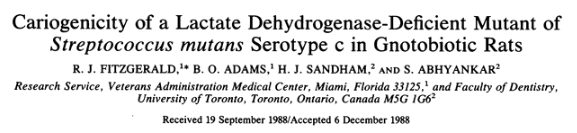
As far as I can tell this is the strongest mechanistic evidence that plaque causes cavities. In that I mean, it’s not good evidence. I don’t think you should extrapolate a diet where rats who had only one type of bacteria in their mouths and drank simple syrup for a month to a real scenario.
Another study made a different bacterium; more precisely getting rid of the main acid forming pathway. They note that they had to make a bunch of other metabolic changes to keep the bacteria alive, and the non acid bacteria formed twice as much plaque in vitro. The increased plaque bacteria seem protective against cavities.
A company called lumina actually is trying to commercialize this, as a product introducing the mutant bacteria into the mouth. They’ve been silent since 2025 after taking preorders so I’m not sure what’s up with them.
There are critics, and I think the critics are right.

With mechanism-based biology you can navel gaze forever, hypothesizing about competitive fitness, metabolism, and whatever. All of it is made irrelevant by a randomized control trial. So when you look an RCT which compares cavity formation with plaque removal, do you see fewer cavities?
The “Personal oral hygiene interventions failed to influence the incidence of dental caries…despite meticulous deplaquing of teeth.”
Huh.
I could only find two study which supported the idea that flossing reduced cavities. These were done by the same scientist, which I find suspicious. The studies were funded by Johnson & Johnson.
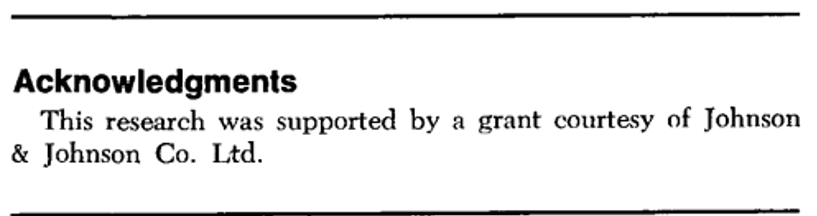
“Professional flossing performed on school days for 1.7 years on predominantly primary teeth in children was associated with a 40% caries risk reduction.”
The study had dentists come into school and floss children daily for 1.7 years; and imagines that flossing was the only difference between the two groups. Imagine someone looking into your mouth every single day, judging, probing. You’re going to care a lot more about making sure you’ve brushed. Who hasn’t feverishly cleaned their teeth in advance of a dentist visit. This could be entirely explained by those kids brushing more consistently with fluoride containing toothpaste.
They also did an experiment where they flossed one side of the schoolkids mouths, and found the side that was professionally flossed every day had less cavities. This should theoretically deal with the randomization problem I note above, and is a stronger experiment. They found less cavities on the flossed than unflossed side. In the absence of the industry funding I’d be more compelled; but even taking it at face value; pediatric teeth and a professional doing the flossing is a narrow scenario that doesn’t really apply to adult self flossing. They don’t report randomization, and note that they aren’t sure how to do the statistics.
Baby teeth are also different than adult teeth; with thinner enamel, different mineralization, and different permeability.
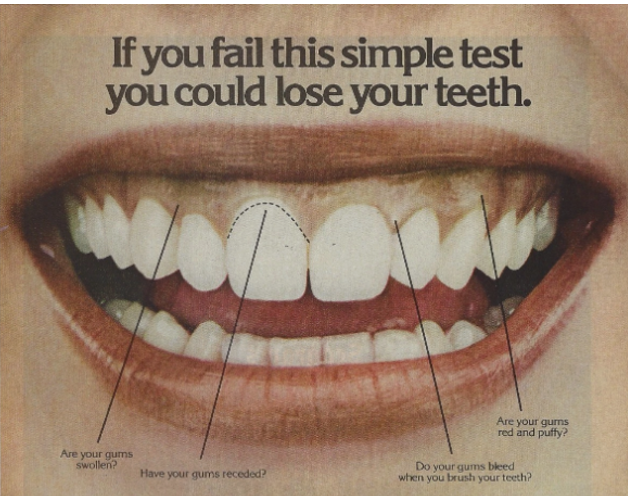
J and J was also publishing ads like this at the time they funded those studies. Very Freudian.
Taken together:
Floss if you like it. It doesn’t seem to reduce plaque or cavities. And remember that dentists have no idea what they’re talking about.